Laundering through mixers and privacy
If peel chains and fragmentation break the link between source and cash-out by topology, mixers and privacy coins try to break it cryptographically — to make it fundamentally impossible (or very expensive) to prove which particular input corresponds to which output. Let us examine how mixer pools such as Tornado Cash work, what CoinJoin is, where the limits of "demixing" lie, what makes Monero special, and why coming out of a mixer does not equal cleanliness in the eyes of compliance.
What a mixer actually does
A mixer (tumbler) is a service or smart contract that accepts funds from many users into a common "pot" and lets you withdraw an equivalent amount, but now without a direct on-chain link to any particular deposit. The idea is to destroy the connectivity graph: an analyst sees that 100 people deposited 1 ETH each and 100 people withdrew 1 ETH each, but cannot reliably say which of the depositors became which of the withdrawers. This is what an "anonymity set" is.
Two large families are distinguished. Custodial mixers (centralized services) physically hold your coins and hand out "other people's" coins from their reserve — but they require trust and themselves become a point of failure and a log file. Non-custodial ones are smart contracts (the archetype being Tornado Cash on Ethereum): you deposit a fixed denomination (say, exactly 1 ETH) and receive a cryptographic "receipt" (a note/commitment). Later, by presenting a zero-knowledge proof (zk-SNARK) that you made a deposit, you withdraw the same denomination to any fresh address — the contract does not reveal which particular deposit you are cashing out.
Tornado Cash: fixed denominations (0.1 / 1 / 10 / 100 ETH) — all deposits of one denomination are indistinguishable, which is what forms the anonymity set.
+ zk-note
hundreds of equal deposits
link broken on-chain
CoinJoin — mixing without a custodian in Bitcoin
In Bitcoin the same task is solved by CoinJoin: several participants jointly build one large transaction with a multitude of identical inputs and identical outputs. From the outside you cannot unambiguously match a particular input to a particular output — you get "collective change." Implementations (Wasabi, the historical Whirlpool by Samourai, JoinMarket) differ in details, but the principle is one: equal denominations + many participants = a large anonymity set. The more identical outputs and rounds, the harder the unraveling.
Demixing and its limits
Contrary to the marketing, a mixer does not make funds "invisible" — it raises the cost of tracing. Analysts apply a set of deanonymization (demixing) techniques, and in many real cases they work:
- Matching amounts and timingIf 9.87 ETH was deposited and soon exactly 9.87 (minus fee) came out to a new address — a likely link. Non-standard, "un-rounded" amounts help.
- A small anonymity setIf a rare denomination was in play in the window and only a couple of deposits, there are few matching options and the withdrawal is "transparent." Anonymity is real only in a large crowd.
- Mistakes on the input/outputA shared gas sponsor, the same wallet for deposit and withdrawal, a characteristic route "before" and "after," address reuse — all of this glues the ends together.
- Clustering "before" and "after"Analysts link an address not only through the mix itself but through the behavior around it: the exchanges the funds came from, the cash-out points they went to.
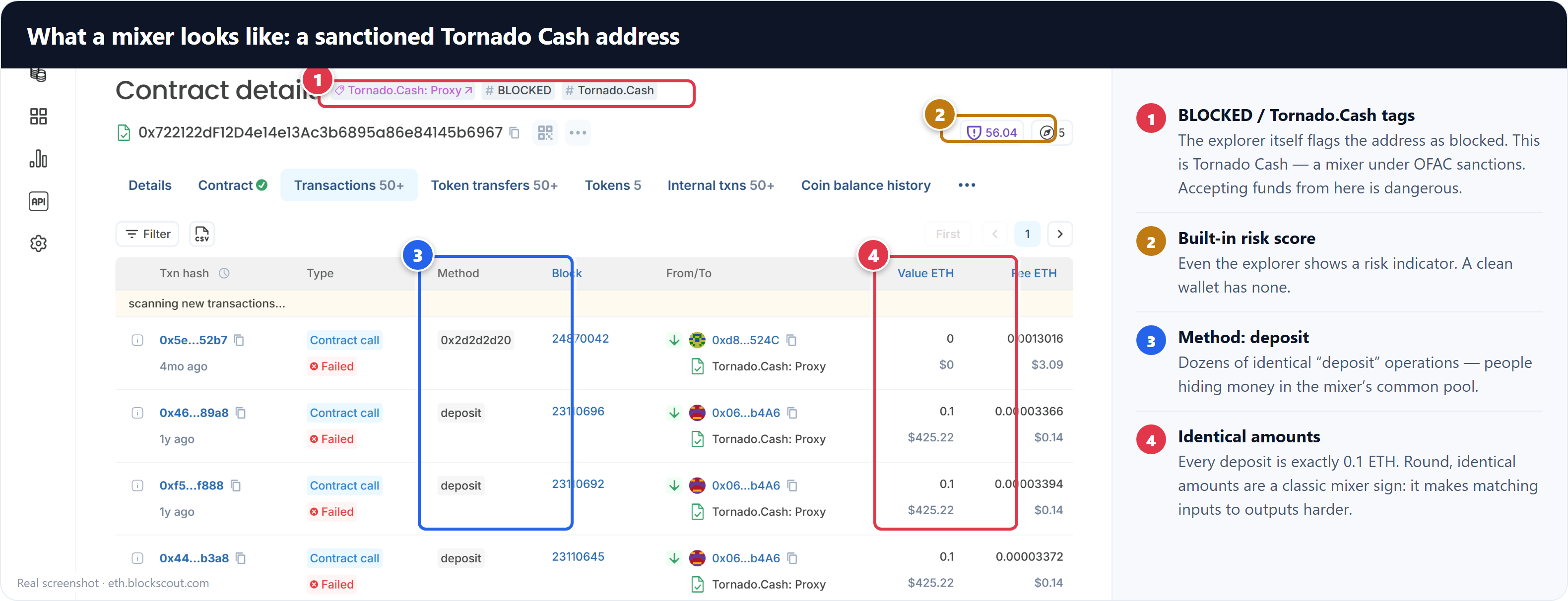
- Contamination of the whole poolIn sanctions cases (for example, the OFAC flagging of Tornado Cash addresses) everyone who so much as touched the contract falls under suspicion, regardless of individual guilt.
Monero: why it is a league of its own
Whereas Bitcoin and Ethereum are transparent by default and privacy in them is "bolted on" with mixers, Monero (XMR) is private by protocol — always and for everyone. Three mechanisms hide three different things:
- Ring signaturesHide the sender: the real input is mixed in with several "decoys," and one cannot say which of them is genuine.
- Stealth addressesHide the recipient: a one-time address is generated for each payment, not publicly linkable to the recipient.
- RingCTHides the amount: the size of the transfer is encrypted and not visible on the chain.
Because of this, classic on-chain tracing on Monero practically does not work. Investigations usually shift to the "edges": entry/exit points on exchanges (where there is KYC), timing correlations, the network layer, and any operational mistakes by the user. This is precisely why many regulated venues simply delist XMR, and the appearance of Monero in a chain is by itself a strong risk signal.
Signs of a "mixing episode" on the graph
- A fixed-denomination depositExactly 0.1 / 1 / 10 / 100 ETH to a known mixer contract — an almost unambiguous marker.
- A break in the graphThe flow "runs into" a known contract/service and "reappears" on fresh addresses — a visually visible "hole" in connectivity.
- Fresh withdrawal addressesFunds come out to clean single-use addresses, often then going straight to an exchange or a bridge.
- A service labelThe address/contract is tagged in databases as mixer/privacy, sometimes under sanctions (OFAC). That is a ready-made flag for scoring.
In sum: mixers (Tornado Cash, CoinJoin) and privacy coins (Monero) break connectivity cryptographically rather than topologically, raising the cost of tracing and forming an anonymity set. But demixing has working techniques — matching amounts/timing, a small anonymity set, operational mistakes, edge clustering — and, more important for practice, the mere fact of mixing is a high-risk flag, while sanctioned services make interaction with them outright toxic. Coming out of a mixer does not "whiten" funds — it marks them. The next lesson is about a technique that takes the flow not into cryptography but across network borders: chain-hopping.
This material is for educational purposes.