Category weights, direction and recency
In the previous lesson we obtained an exposure profile: "22% through no-KYC P2P, 4% through a mixer, 6% through darknet". But 4% contact with a sanctioned address and 4% contact with an online casino are a completely different level of alarm. In this lesson we examine how weights are assigned to exposure shares, why the direction and recency of contact change the assessment, what hard flags are, and how a single number from 0 to 100 is born out of all this.
Why sanctions weigh more than casinos
Not all risk categories are equal. Scoring assigns each category a weight — a multiplier reflecting the severity and legal consequences of contact. The logic of the weights follows from real regulatory risk, not from abstract "badness".
- Maximum weight: sanctions (OFAC/EU/UK), terrorist financing, CSAMContact with a sanctioned address is a violation carrying criminal and blocking liability in most jurisdictions. Strict liability applies here: intent does not matter, the mere fact does. Even a small share pulls the assessment into the red zone.
- High weight: darknet markets, stolen funds (hacks), ransomware, scamsDirect proceeds of crime. Severe, but usually assessed by share rather than by the fact of contact.
- Medium weight: mixers/tumblers, bridges with a bad history, high-risk exchanges without KYCObfuscation tools. Not criminal in themselves, but they sharply reduce the transparency of a fund's origin.
- Low weight: online casinos, gambling, P2P with partial KYC, mining poolsLegal in many jurisdictions. They raise attention, but rarely become a stop factor on their own.
Incoming versus outgoing exposure
The direction of the money flow changes the meaning of the risk, and a good engine weighs these two directions differently depending on the task.
Example: a wallet that receives a salary from an exchange but sends it to a sanctioned service is an outgoing problem, and it is invisible if you look only at sources. And vice versa: a wallet with clean withdrawals but dirty inflows is dangerous for whoever accepts those inflows. That is why a report always has two exposure blocks, and they must not be confused.
Recency: how long ago the contact was
Risk ages. Contact with a mixer a week ago and contact three years ago are a different level of current threat. Engines introduce a recency factor (recency / time decay).
- Fresh contact (days–weeks). Full weight. The money is "hot", the link is current.Especially important for hacks and sanctions: freshly stolen funds are actively tracked.
- Medium age (months). The weight is partially reduced.The wallet may have changed behaviour, the funds may have been mixed many times over.
- Old contact (years). The weight is markedly lower, but not zero for heavy categories.A sanctions or CSAM contact is not "forgiven" by time the way a P2P casino is.
Hard flags: when the number no longer matters
Standing apart are hard flags — conditions under which the assessment is forced to the maximum regardless of shares, weights and recency. These are "red kill switches".
- The address is directly on a sanctions listThe very address being checked appears on the OFAC SDN / EU / UK. Assessment = 100, discussion closed.
- Direct contact (1 hop) with a sanctioned addressReceived from / sent to an address on the list. Strict liability.
- Funds in "frozen" status by a stablecoin issuerUSDT/USDC blocked — this is confirmation from the issuer.
- CSAM / terrorism in direct proximityZero tolerance regardless of amount.
The point of hard flags is not to let a catastrophe be "averaged out". Without them, a wallet with 2% direct sanctions exposure and 98% clean funds would get a low weighted assessment and pass the check. A hard flag overrides all the arithmetic: 2% of sanctions matters more than 98% of cleanliness.
How a 0–100 number comes out of all this
Let's assemble the whole formula. The final assessment is a pipeline:
from taint analysis
sanctions ≫ casino
source/dest, age
0–100
- Take each exposure share from the taint analysis (Lesson 4.1).For example, 6% darknet at the 2nd hop.
- Multiply by the category weight. Darknet is high, a casino is low.This is how severity is accounted for quantitatively.
- Adjust for direction and recency. Fresh outgoing exposure to sanctions is almost the maximum.Old incoming casino is almost zero.
- Sum the weighted contributions and normalise onto a 0–100 scale.Usually non-linearly: the first percentages of a heavy category raise the assessment faster than the later ones.
- Check the hard flags. If at least one has triggered — the assessment is forced to the maximum.It overrides the whole calculation.
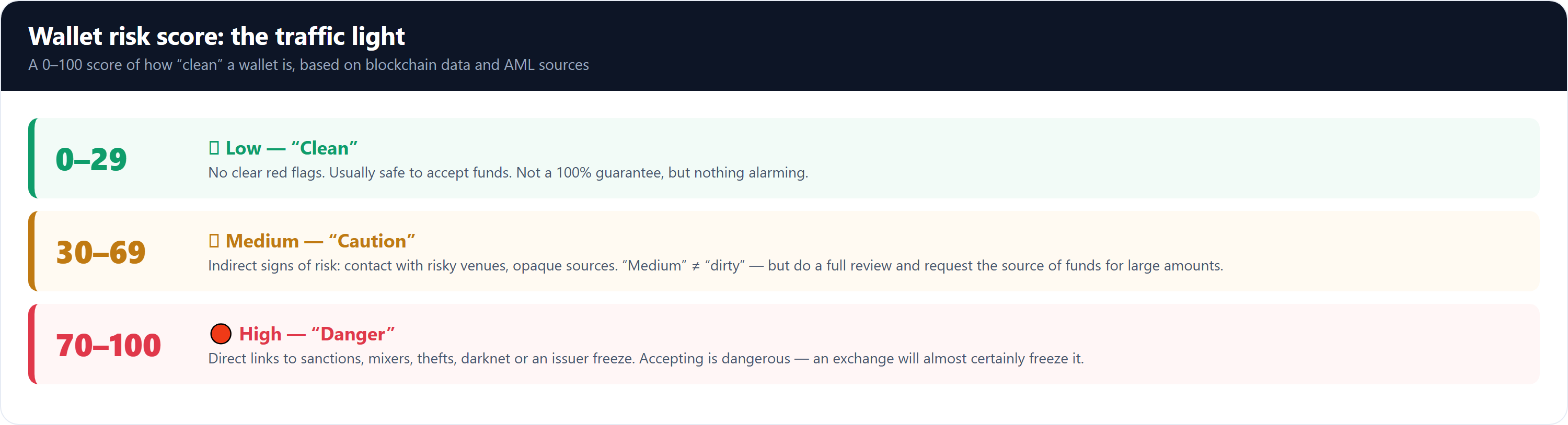
The finished number is laid out into a "traffic light". The band boundaries are a matter of threshold policy (see Lesson 4.3): one service will call 55 "medium", another "high".
How to read the risk bands
- 0–30 (green)Clean or background noise. Safe to proceed, standard procedures.
- 30–70 (yellow)Attention required: request the source of funds, deepen the check, document the decision (EDD).
- 70–100 (red)High risk or a hard flag. Refuse, freeze, escalate to compliance.
This material is for educational purposes only.