AMLConsensus · course
Section 2 · Lesson 2.4
Programme · Lesson 2.4
Reading an address page: a wallet's profile in a minute
Clicking an address opens its wallet — and from that page you can build a portrait in a minute: who this is, where they get their money, where they send it, and whether it's worth dealing with them.
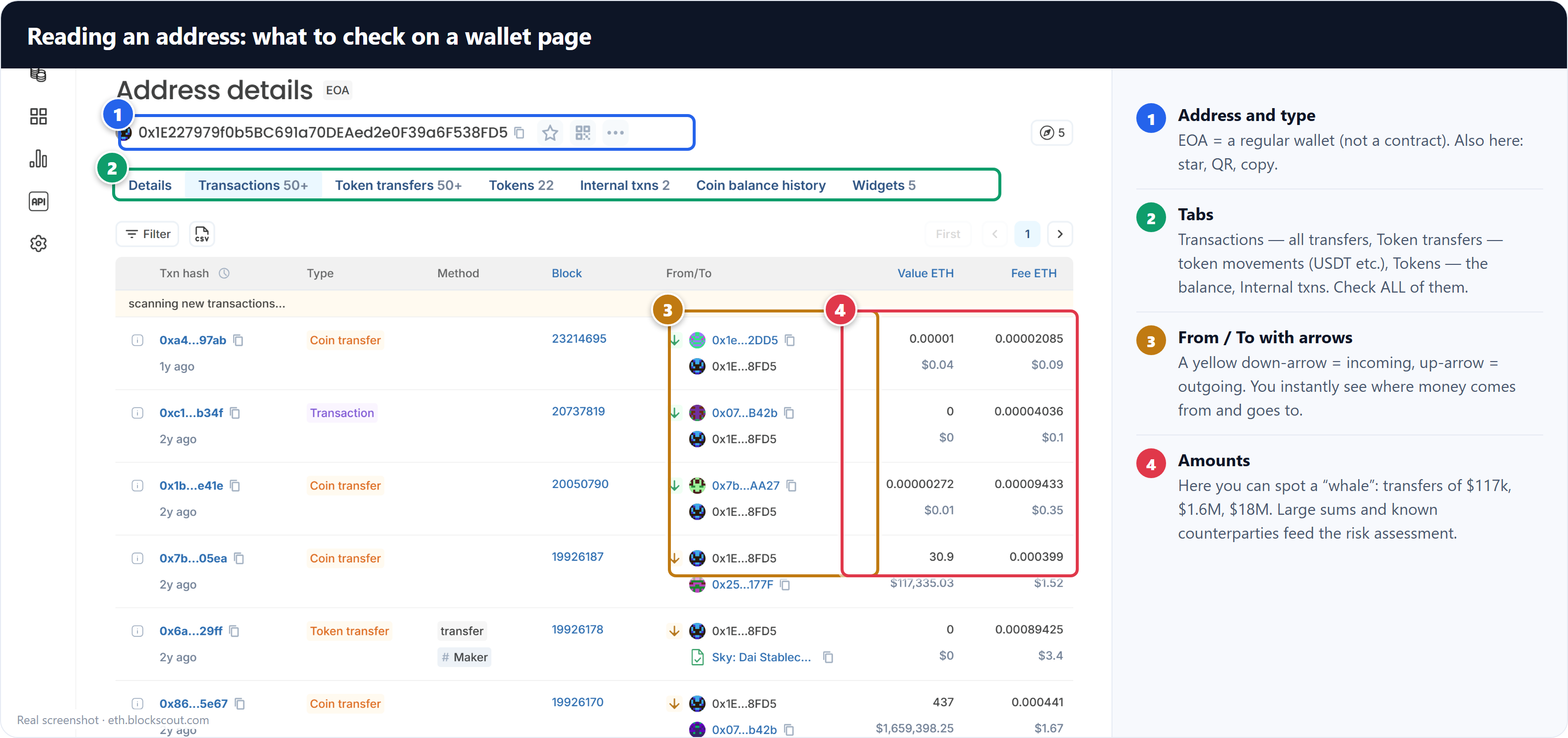
A real wallet page on eth.blockscout.com.
The reading order — four steps
- The address type. The label
EOA— an ordinary person's wallet;Contract— a smart contract (an exchange, a protocol, a token).This changes the interpretation: a transfer to a contract is usually an interaction with a service, not a payment to a person. - The tabs — go through ALL of them. Transactions (coin transfers), Token transfers (USDT/USDC movements), Tokens (what's in the balance), Internal txns (contracts' internal transfers).Fraudsters often hide activity in tokens — the Transactions tab won't show it.
- The From/To column with arrows. An arrow pointing in — money arrived at the address; pointing out — it left.This shows in a second where the wallet gets its funds and where it sends them.
- Amounts and counterparties. In the example you can see transfers of $117k, $1.6M, $18M — this is a "whale."Clicking a counterparty shows whether it's an exchange, a mixer, or a private individual.
What to look at first
- Wallet ageThe date of the first transaction. A fresh wallet (days old) with large turnover is a typical "pass-through." An old one with a stable history is a good sign.
- Volumes and frequencySharp bursts of activity, identical round amounts, dozens of same-type transfers — reasons to look closer.
- Top incomingWhere does the money come from? Labels of KYC exchanges (Binance, Bybit) mean a transparent source. Nameless one-day addresses mean dig deeper.
- Top outgoingWhere does it go? Steady withdrawals to a single exchange — an ordinary user. A fan-out across dozens of addresses — possible passthrough / cash-out.
An example interpretation
The wallet from the screenshot: type EOA, a solid age, incoming and outgoing — large amounts with known counterparties (we see transfers of millions of dollars and protocol labels such as Sky: Dai). This is the profile of a major market participant, not a one-day wallet. That alone doesn't make it "clean" — but it sharply reduces the chance that we're looking at a fresh "pass-through" for cash-out.
The link to AML risk. Everything you read by hand — age, sources, labels, amounts — an AML service gathers automatically and turns into a risk score (Section 4). By understanding the address page, you understand where the score comes from and why it can be trusted.
Don't draw a conclusion from a single tab. An empty Transactions tab does not mean "a clean wallet" — all the activity may be in tokens. Always open Token transfers (next lesson).
Lesson summary
- The reading order: address type → tabs → directions → amounts and counterparties.
- Key signals: age, volumes, labels of incoming/outgoing.
- A fresh wallet + large turnover = a "pass-through"; an old one + a stable history = a good sign.
- Check ALL tabs, especially Token transfers.
All screenshots are real (eth.blockscout.com).