The three stages of laundering in crypto: placement, layering, integration
Money laundering is not a single act but a process made up of three classic stages. This model was devised long before cryptocurrencies existed, yet it describes the blockchain beautifully. Understanding the stages lets you read a wallet's history as a coherent story: where the money entered, how it was tangled up, and where someone tried to "legitimise" it.
The classic laundering model
The international standard describes three sequential stages:
- PlacementIntroducing "dirty" funds into the financial system.
- LayeringA multitude of operations that break the link to the source.
- IntegrationReturning now clean-looking money to the owner under a legitimate back-story.
Offline it looked like this: cash from crime is deposited into an account through a front business (placement), run through a chain of firms and countries (layering), and then used to "buy" real estate or received as salary/dividends (integration). On the blockchain those same three stages take a digital form — and, importantly for us, each one leaves traces that analytics can read.
Stage 1: Placement — how the "dirt" gets onto the blockchain
In the crypto world, placement is the moment when a criminally obtained asset first lands on an address the wrongdoer controls, or is put into circulation. It takes various forms:
- Direct theft in cryptoAn exchange hack, draining a wallet via phishing, exploiting a DeFi protocol — the "dirty" coins are already on-chain.
- Ransom / extortionRansomware payments, where the victim themselves transfers crypto to the attacker's address.
- FraudDeceived people's funds pool into a scam project's wallets.
- Bringing offline money into cryptoCash is swapped for crypto through P2P or dodgy exchangers, to then be "laundered" on-chain.
From a tracing standpoint, placement is the most "vivid" point: this is where the trail begins, and it is this address that analysts flag as the source. Everything that flows onward from it inherits part of its "dirt" (more on this in the concept of taint in the section on exposure).
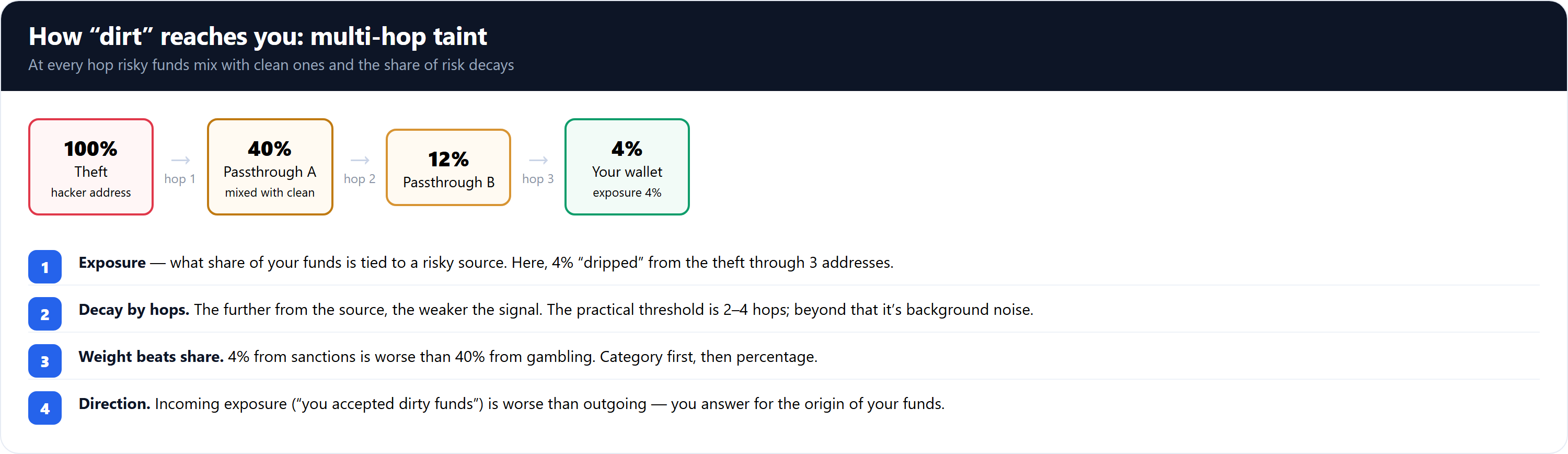
Exposure (taint) spreads from the source down the chain of transfers, weakening with every "hop."
Stage 2: Layering — the heart of laundering in crypto
Layering is the obfuscation stage, and it is in cryptocurrency that it is most developed and technologically advanced. The aim is to make the link between the dirty source and the final address practically unreadable. There is no shortage of tools:
- Splitting and chains of transfers. The amount is broken into pieces and run through dozens or even hundreds of intermediate addresses (a peel chain).Every "hop" moves the coins further from the source and lengthens the chain to analyse.
- Mixers and tumblers. Services such as mixing protocols blend the funds of many users, breaking the input–output link.Passing through a known mixer is a strong risk signal for any AML engine.
- Cross-chain bridges. Moving assets from one network to another (Ethereum → BNB → TRON) complicates end-to-end tracing, because the trail "hops" between blockchains.
- Swapping between assets. Exchanging ETH → stablecoin → another token → back through a DEX changes the "form" of the asset without ever leaving the blockchain.
- Chain-hopping and privacy coins. Converting to privacy coins (Monero and the like) severs the public trail almost entirely.
theft/scam
+ mixer
to another network
address
Why is layering the main stage in crypto? Because on the blockchain creating a new address is free and instant, transfers are cheap, and obfuscation tools are available to anyone. Where an offline launderer spent weeks and bribed bankers, a crypto launderer pushes funds through hundreds of addresses and three networks in minutes. The flip side: every such step stays on the blockchain forever. Analytics can't see names, but it can see structure — and the characteristic patterns of layering (a peel chain, a surge of transfers, an entry into a mixer) become evidence in themselves.
Stage 3: Integration — legitimisation
At the final stage the "laundered" funds are returned to the owner in the guise of lawful income. In crypto this most often means:
- Cashing out to fiat via an exchangeHere the coins meet KYC — and here is where the AML check meets them. If layering went "successfully," the source is hidden and the money looks clean.
- Buying real assetsReal estate, cars, luxury goods paid for with crypto.
- The investor/trader "back-story"The funds are dressed up as profit from trading or investment.
- Injection into a legitimate businessCrypto is converted into a company's working capital.
For an AML specialist, the integration stage is the last line of defence. It is at the fiat cash-out that the exchange must recognise that clean-looking money has in fact been layered from a dirty source. The quality of the tracing decides whether the launderer is caught here or slips through.
What this gives you in practice
- Read the history as a storyPlacement — where from; layering — how it was tangled; integration — where it cashes out. That way the risk report stops being a set of numbers.
- Beware the "exhaust" of layeringIf your counterparty hands you coins that just came out of a mixer or a long peel chain, that's a red flag.
- Understand the exchange's logicIt catches you at the integration stage. Your defence is a clean chain and proof of origin.
With that we conclude the introductory section, "AML Basics." You've learned what AML/CFT is and why crypto's pseudonymity is no shield (Lesson 1.1), who sets the rules at the international level (1.2), and the model by which dirty money moves (1.4). Ahead in the course: the concrete tracing tools, risk scoring and the specifics of individual networks.
This material is for educational purposes and does not constitute legal advice.